When Your Teen Becomes a Stranger
What silence may actually be protecting.

A Family Narrative + Practical Parent Workbook
You ask because you care. You advise because you want to protect them. You push because their future matters. And sometimes, those loving instincts are exactly what make a teenager say less.
The Next Honest Sentence follows one imperfect family through silence, comparison, academic pressure, identity, risky choices, broken trust, boundaries and the difficult transition towards independence.
For parents, caregivers and families navigating the teenage years.
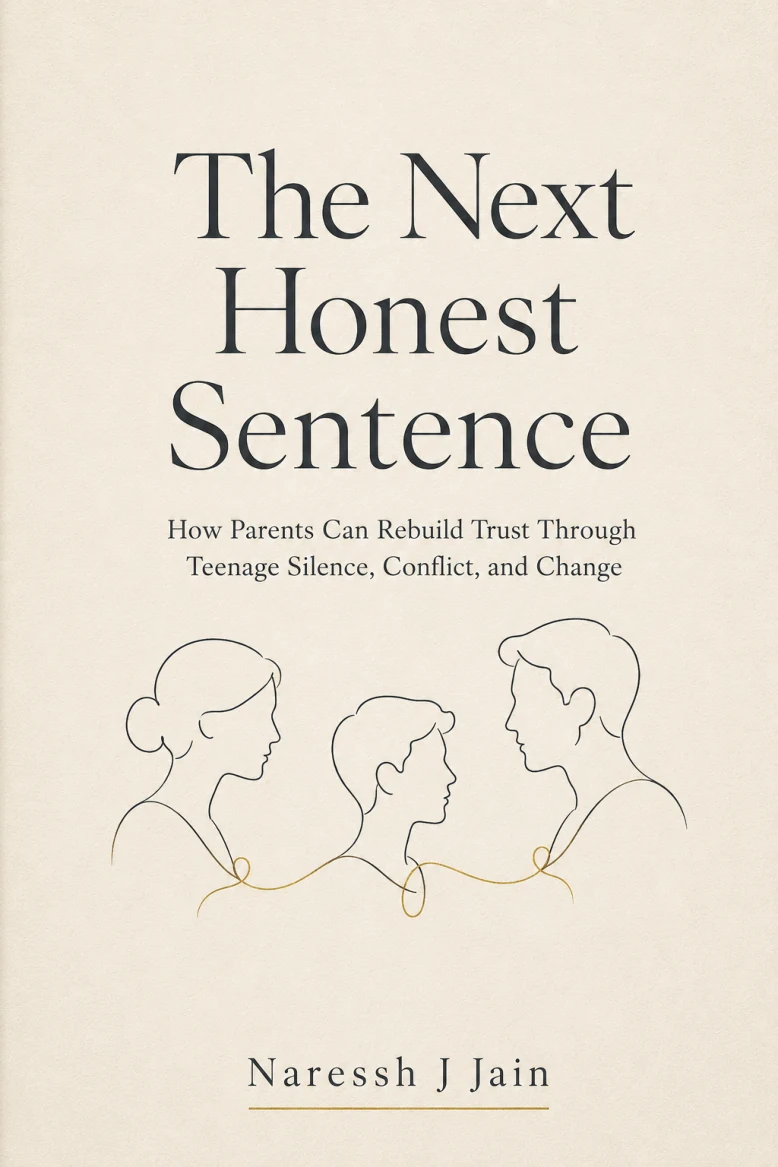
The Moment Many Parents Know Too Well
Your teenager says “Fine.”
You know they are not fine.
You ask another question.
They withdraw further.
You give advice.
They hear criticism.
You tighten a boundary because you are afraid.
They experience it as proof that you do not trust them.
What if the goal was not to make your teenager talk — but to make home a safer place for honesty?
A teenager’s silence is not always about having nothing to say. Sometimes it is about deciding whether it is safe to say it.
The question is not only, “Why won’t my teenager talk?”
It may also be, “What happens when they do?”
Not Another Perfect-Parent Book
Andrew and Joshua love their children. They also interrupt, assume, overreact, compare, fix too quickly, apologise badly and repeat mistakes they thought they had already learned from.
Aarav and Ruth are not problems waiting to be solved either. They hide things, push boundaries, need privacy, need accountability and need somewhere safe enough to be unfinished.
That is where this book begins: with a family that loves one another and still gets it wrong — then tries again.
Ten Chapters · One Family
Adolescence is not one problem to solve. It is a relationship learning how to change.
What silence may actually be protecting.
Identity, culture, migration and belonging without forcing a tidy story.
How marks, siblings, friends and social media quietly turn love into ranking.
What to do with the few seconds between being triggered and reacting.
Learning when your teenager needs ears, ideas, action — or space.
Ambition, careers, university, money, AI and the fear behind the future.
Alcohol, vaping, consent, parties, online harm and the talks families postpone.
Privacy, consequences, broken trust and rebuilding freedom.
Allowing independence without abandoning responsibility.
Preparing for the moment when parenting increasingly means letting go.
Story + Practice
The story gives you the family. The workbook gives you somewhere to begin with your own.
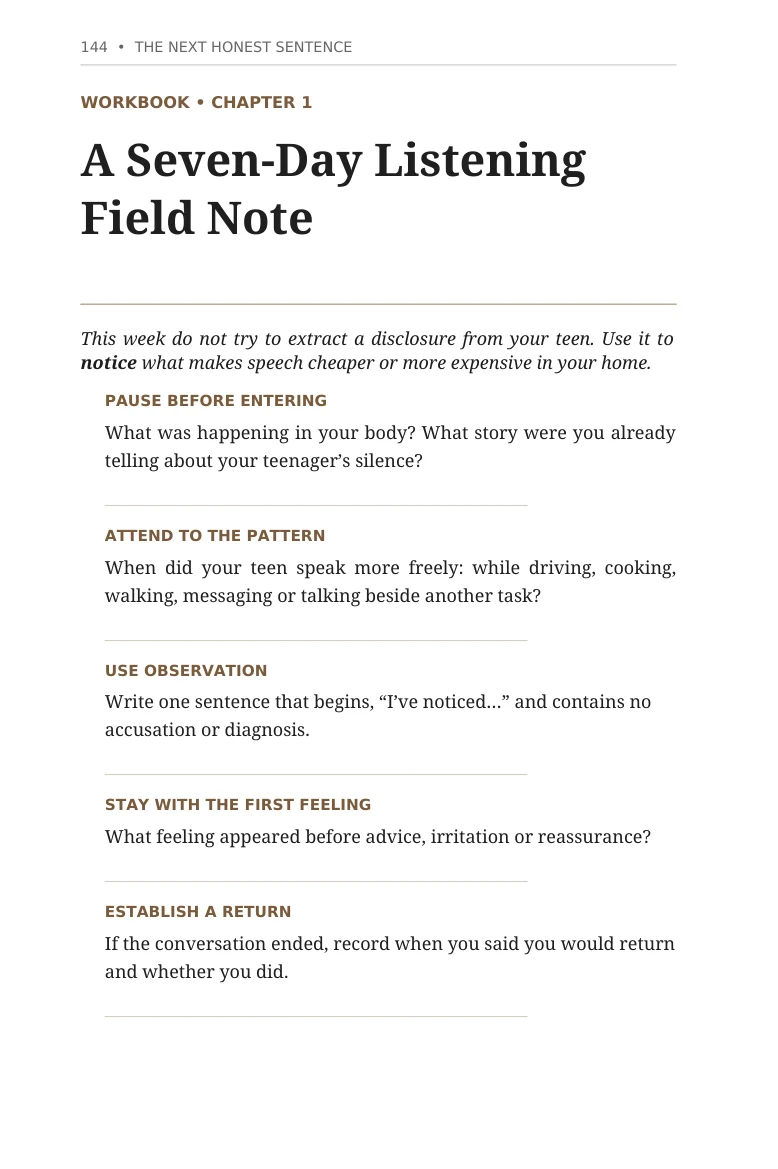
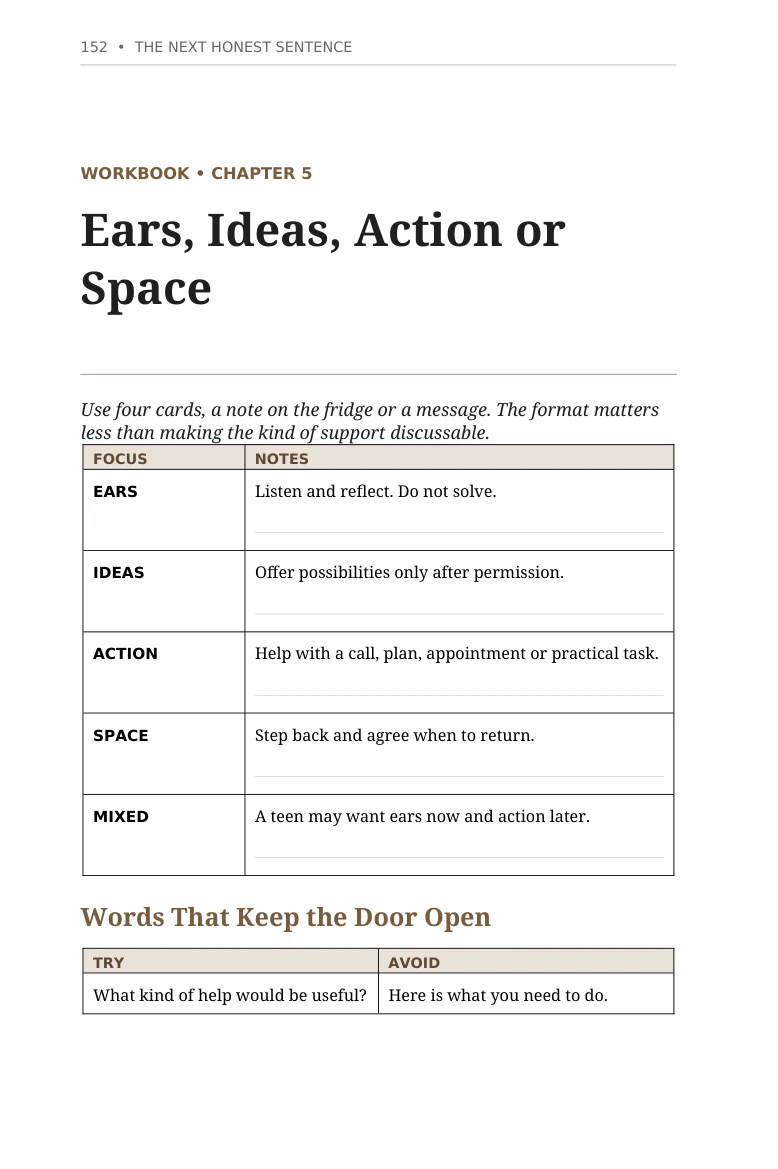
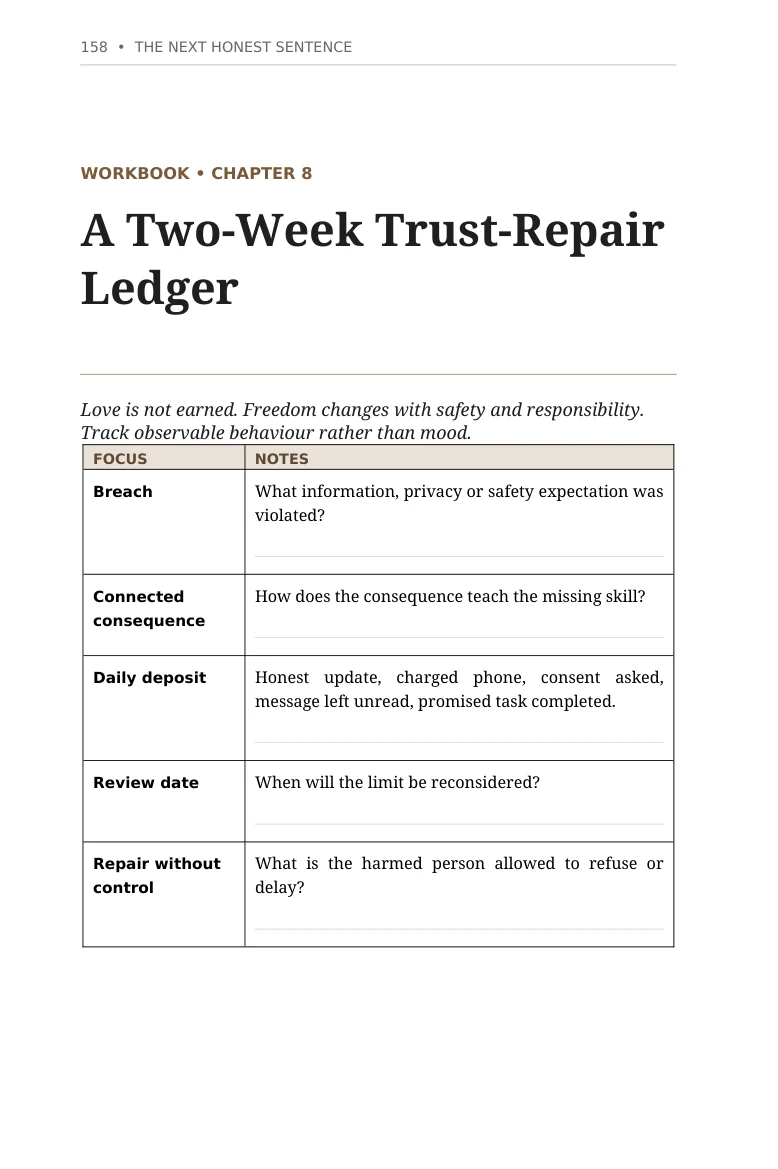
Practical Tools
Use what fits your family. Revise what does not. The goal is not a completed worksheet — it is a relationship that can keep changing honestly.
Notice when your teenager speaks most easily and what makes communication cheaper or more expensive at home.
A simple way to ask what kind of help is actually needed before jumping in with advice.
Create a shared way to pause a heated conversation without using the pause to avoid responsibility.
Move future-planning conversations away from prestige and panic towards meaning, skills, reality, options and ownership.
Prepare for the call no parent wants to receive with a code phrase, safe pickup options and immediate safety questions.
Reconnect freedom with observable responsibility rather than surveillance, moods or vague promises.
Small Shifts in Language
“Why won’t you ever talk to us?”
“I’ve noticed we keep missing each other. I’m not asking you to explain everything now.”
“Here is what you need to do.”
“What kind of help would be useful?”
“If you have nothing to hide, hand over your phone.”
“I need enough information to keep you safe, not every private message.”
Small changes in language do not repair a relationship overnight. They can change what becomes possible next.
Who This Book Is For
“I don’t know how to talk to them anymore.”
This book is for parents whose once-talkative child now answers in one word. For families navigating academic pressure, career decisions, cultural identity, comparison, social media, privacy, parties, boundaries or broken trust.
It is for the parent who gives advice too quickly. The parent who worries too quickly. The parent whose love sometimes arrives sounding like pressure.
And it is for families approaching the strange final stage of adolescence, when loving someone increasingly means preparing them to need you differently.
Compassionate · Practical · Responsible
The book offers general educational guidance, not individual medical, psychological, legal or financial advice.
Its research and safeguarding notes help readers distinguish everyday family conflict from situations where qualified professional or emergency support may be needed.
Reader Reviews
This section is intentionally ready for your ARC, BookSirens and Amazon reviews once they are available.
“Add a short, high-impact review excerpt here after publication.”
— Advance Reader“Use a review that describes what felt recognisable, useful or different.”
— Verified Reader“Keep each testimonial to two or three lines for maximum credibility.”
— Parent ReaderThe Next Conversation Doesn’t Have to Be Perfect
You do not need a perfect script. You do not need to solve adolescence. Sometimes progress is smaller than that: a door left open, an apology without an excuse, a question without an interrogation, a boundary without humiliation.
Start with the next honest sentence.
How Parents Can Rebuild Trust Through Teenage Silence, Conflict, and Change
Amazon and eBook links will be added once the book is listed. Buying direct is available now.
FAQ
Teenage relationships are at the heart of the story, but many ideas — listening, comparison, boundaries, repair, identity and growing independence — will also be useful to parents approaching the teenage years.
Both. The Hughes family’s story unfolds across ten connected chapters, while a dedicated workbook brings together exercises, conversation language, weekly practices and reflection tools.
No. Readers can return to the exercises most relevant to what their family is facing. The book encourages readers to use what fits their family’s circumstances and leave what does not.
No. The book provides general educational information and directs readers towards qualified professional or emergency assistance when safety or serious distress is involved.
No. It makes room for accountability, consequences, safety and boundaries while exploring how those can coexist with dignity, privacy and growing independence.